One of the most common reasons business owners put off getting a new website isn’t the cost. It’s not the time, either.
More often, it’s simply because they don’t know what to expect – what the website development process actually looks like and what it’s like to work with a web agency
What happens after you send an enquiry? Who does what? How long does a website take to build? Do you have to write all the copy and come up with the design yourself? What happens if you don’t like the result? And what happens when the website is finally ready to go live?
Without answers to these questions, the whole process can seem much more complicated than it really is.
That’s why in this article, we’ll walk you through the 7 steps of building a website and working with a web agency – from the first conversation to the moment your new website goes live.
The goal is simple: you should know what you can expect from us, what we need from you, and what working with us looks like from start to finish.
Table of Contents
Step 1: We Get to Know Each Other without Obligation
Everything starts with a conversation.
We arrange a meeting, either online or in person, where we get to know you, your business and your project.
We’ll talk about what you do, who your customers are, what you want your new website to achieve, and what kind of results you’re expecting.
This isn’t a sales call where we try to sell you a predefined package.
First, we want to understand what you actually need.
Sometimes, during the conversation, it becomes clear that we’re not the right fit for each other, or that you need something different from what we offer at that particular stage of your business.
And that’s perfectly fine.
Even then, we’ll do our best to give you practical advice and point you in the right direction. A conversation shouldn’t only be valuable if it ends with us working together.
If we believe there’s a good basis for working together, we move on to the next step.
Step 2: Proposal and Strategy
Within 24 hours of our meeting, you’ll receive a proposal.
But you won’t just get a price.
Along with the proposal, we’ll provide an initial strategy: what we recommend, why we recommend it, what would be useful to do right away, what can wait, and what we don’t think you need at all.
You’ll also receive a clear list of everything we need from you before we can get started.
Why is this important to us?
Because a proposal shouldn’t just be a number followed by a list of deliverables.
We want you to understand from the beginning what you’re getting, why you need it, and how the proposed solution fits your business.
That way, you can make an informed decision rather than simply taking a chance.
Step 3: Contract and Getting Started
If you accept the proposal, the next step is the contract.
It clearly defines everything we’ve agreed on: the scope of the project, deadlines, responsibilities, pricing and ownership. Everything is in writing.
This protects both you and us.
You know what to expect and when to expect it, and we know exactly what we’re responsible for delivering.
We don’t start work without a contract.
That’s our rule, and so far, we’ve found it to be good practice. Clear expectations at the beginning usually mean fewer misunderstandings later.
Once everything has been agreed and the contract has been signed, the project can begin.
Step 4: Design in Figma – See Your Website Before It’s Built
This is often the part of the process that clients are pleasantly surprised by.
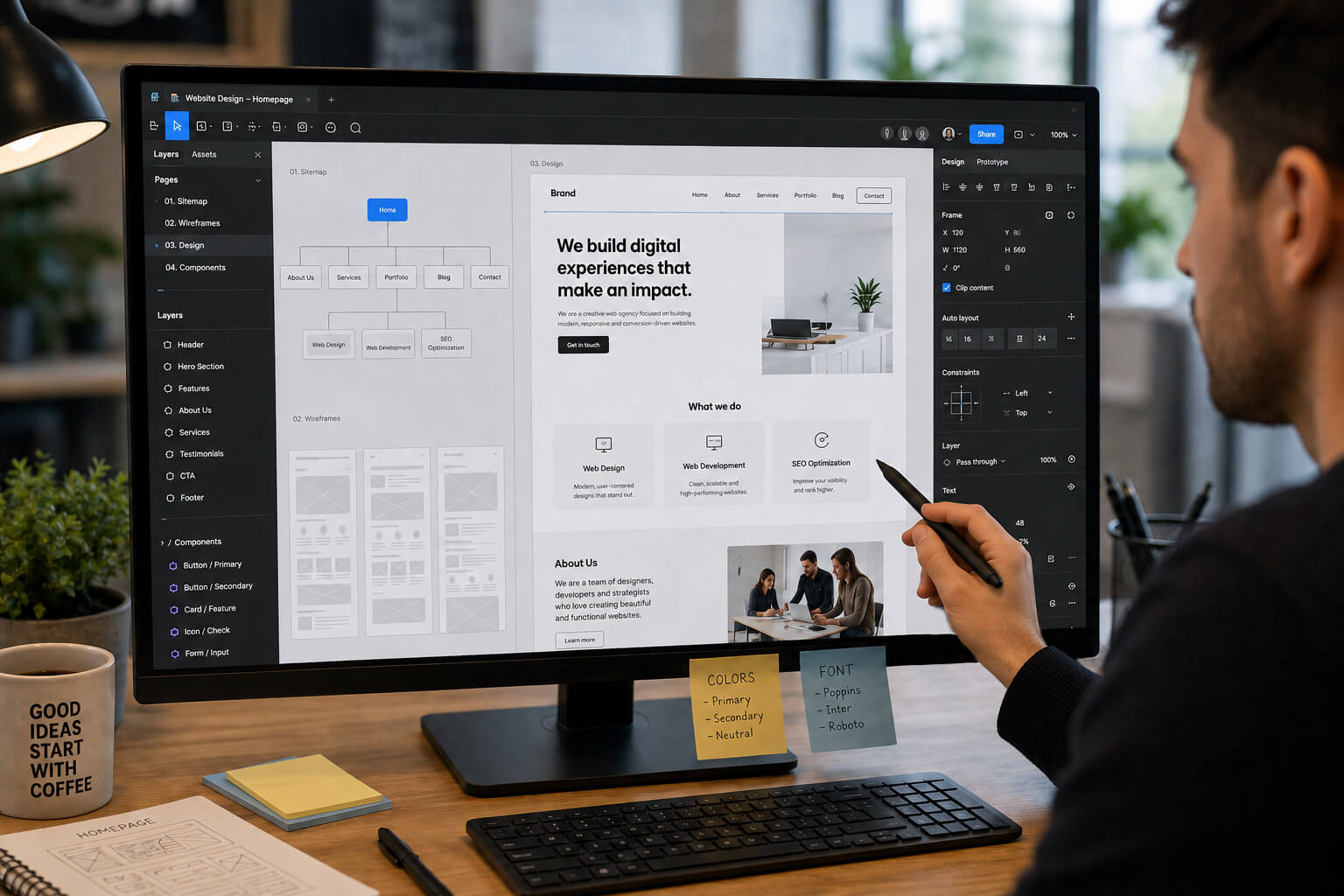
Before a single line of code is written, we design the entire website in a tool called Figma.
That means you don’t have to imagine what your future website will look like; you’ll actually see it.
The layout, colours, fonts, images, buttons, sections and individual pages can all be reviewed and refined before development begins.
This is important for one simple reason: making changes is much easier before development than after it.
Want to change the colour of a button? Move a section? Rearrange the content? Try a different approach?
We can do all of that while the website is still in the design stage.
This is also when you have the opportunity to give feedback, ask questions, and work with us towards the final visual direction.
Only once you’re happy with the design do we move on to development.
Step 5: Development and Progress Updates
Once the design has been approved, development begins.
And there’s one thing we consider particularly important here: you shouldn’t have to wait until the end of the project to see what’s happening.
We host the website on our development server and give you a link where you can follow its progress in real time.
As pages are built, you can review them.
You don’t have to wait until the end for us to say, “It’s done,” before seeing the result for the first time.
If you notice something that doesn’t match what we agreed on, or you have a question or suggestion along the way, you can raise it during the process.
This makes the collaboration more transparent and makes potential changes much easier to handle.
Step 6: Testing and Technical Preparation
Once the website is technically complete, we don’t immediately launch it.
First comes a testing and technical preparation phase that covers several important areas:
how the website looks and functions across different devices — phones, tablets and desktops;
how it behaves across different browsers;
loading speed and opportunities for further optimisation;
integration with tools such as Google Analytics, Facebook Pixel and any other agreed applications;
essential legal pages, such as Terms of Use and Privacy Policy;
a GDPR consent banner, where applicable;
the basic SEO elements needed for a technically sound launch.
We also take care of the initial technical SEO setup, including the sitemap, meta descriptions and submitting the website to Google for indexing.
The goal of this phase isn’t simply to make sure the website “works.” The goal is to make sure it’s technically sound, fast, functional, and ready to be published.
Only after we’ve completed these checks is the website ready to launch.
Step 7: Launch
Once the design, development, testing and technical preparation are complete, we reach the moment you’ve probably been waiting for from the beginning — your website goes live.
The website is moved to the production server and becomes publicly accessible.
What About the Domain and Hosting?
The domain is always yours – no exceptions.
We never register domains in our own name. We believe your domain should remain under your control because it’s part of your business and your digital assets.
Hosting depends on what works best for you.
If you want us to take care of your website maintenance, hosting is included free of charge as part of our ongoing service. If you’d rather host the website yourself, that’s absolutely fine too – we’ll point you in the right direction and help you understand how to set it up.
Our goal isn’t to tie you to us through technical details.
Our goal is for you to know what you have, where it’s hosted, and who has control over it.
What Do You Get Once the Website Is Complete?
At the end of the process, you don’t just get a “finished website.”
You get a website that is completely yours.
The domain, content, and code remain your property.
We’ll also walk you through the website and show you how to update content, add new things, and manage it yourself. Of course, if you’d rather have us continue taking care of the website, we can do that too.
The goal is to give you a website you understand, can use, and have control over.
So, What Does Working with a Web Agency Actually Look Like?
When you put it all together, the process looks like this:
You don’t need to know how websites are built before starting a project with us. You don’t need to be a designer, developer or SEO specialist.
Your job is to tell us about your business, your goals, and your expectations.
Our job is to guide you through the process, explain what we’re doing, and build a solution that makes sense for your business.
If you’ve been putting off getting a website because you weren’t sure what to expect, we hope this article has made the process clearer.
It doesn’t have to be complicated.
When the steps are clear, expectations are agreed upon upfront, and communication stays open, building a website becomes a much more predictable process.
Want to Talk About Your Website?
The first step is a simple, no-obligation conversation.
Tell us what you do, what you want to achieve and what’s currently missing.
We’ll work with you to understand what you need and whether we’re the right team to help.
WordPress website owners, beware! A new malware strain called cloudswiftcdn has emerged, specifically targeting vulnerabilities in WordPress websites....





Comments are closed here.